Getting Fiber With a Smaller Appetite
How to fit fiber into smaller meals: which foods government sources list, how to add them gradually, and how to read a Nutrition Facts label when you are not eating much.
On this page
The short answer
With a smaller appetite, you get fiber by making each small portion count: choose foods government sources list as fiber-rich, such as oatmeal, beans and lentils, berries, pears, and cooked vegetables, and add them a little at a time. Published daily targets differ by source and age, from 21 to 38 grams for adults, so ask your clinician or dietitian what fits you. If you have severe or ongoing stomach pain, vomiting, or cannot pass stool or gas, get care first rather than adding fiber.
When should you get care before adding fiber?
Fiber is a food question. These symptoms are a medical one. MedlinePlus lists the following for semaglutide injection as reasons to call your doctor immediately or get emergency medical treatment: ongoing pain that begins in the upper left or middle of the stomach and may spread to the back, with or without vomiting; decreased urination; fainting or dizziness; and "severe stomach or intestinal problems." 1 Do not try to fix those with food.
Constipation that does not improve, or that arrives with strong pain, swelling, or vomiting, also deserves a call. Our constipation guide covers the warning signs in detail and what to tell your care team. If you are eating very little and are not sure it is enough, say so; it is information your clinician can use, not a failure.
How much fiber do you need?
Sources disagree on one number because they use different age and sex groups. MedlinePlus says the recommendation for older children, adolescents, and adults is 21 to 38 grams of fiber a day. 2 Its high-fiber foods page gives 25 grams a day for women aged 19 to 50. 3 NIDDK says adults should get 22 to 34 grams a day depending on age and sex. 4 The FDA's Daily Value used on food labels is 28 grams. 5
These are general targets, not a prescription. Whether any of them fits you depends on your health, your medicines, and how much you are eating. NIDDK suggests talking with a health care professional, such as a dietitian, to plan meals with the right amount of fiber for you. 4
Which foods give you fiber in small portions?
The lists below come from MedlinePlus and NIDDK. We have sorted them by how much effort and appetite each one asks for, which is our own arrangement, not a ranking from either source. We have left out gram counts per food because we did not open a food-composition database for this page; the label method in the next section gives you the real figure for packaged foods.
| If this is your day | Foods to try | Listed by |
|---|---|---|
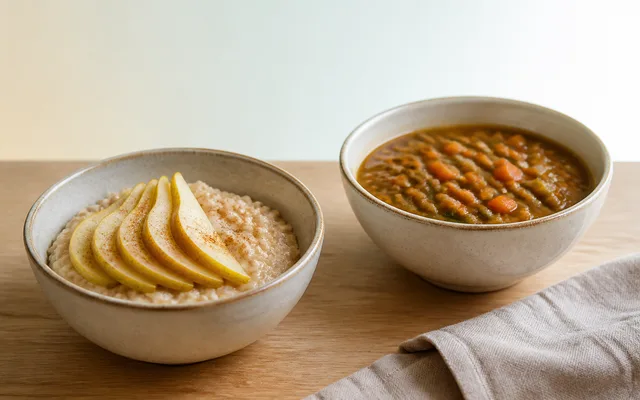
| Little appetite, want something soft | Oatmeal, tender cooked vegetables such as asparagus, beets, mushrooms, and pumpkin, baked potato or sweet potato with the skin | 3 |
| Want something that needs no cooking | Berries, pears, bananas, apples, kiwis, tangerines, raw carrots, a handful of almonds, pistachios, or pecans | 3 4 |
| Want a small, filling dish | Lentil soup, black beans, chickpeas, split peas, kidney beans | 3 4 |
| Want a grain you can keep on hand | Whole-wheat bread or pasta, brown rice, quinoa, shredded wheat or bran flake cereal | 3 4 |
MedlinePlus notes that whole-grain products have more fiber than refined grains, for example whole-wheat versus white bread, and that taking the peel off fruits and vegetables lowers the fiber you get. 2 3 Most high-fiber foods contain both soluble and insoluble fiber, which is why it helps to eat a variety. 2
Several of these also carry protein. Our protein meal ideas use lentils, beans, tofu, and oats, so one small bowl can serve both goals.
How do you add fiber without gas and bloating?
Slowly. MedlinePlus says eating a large amount of fiber in a short period can cause gas, bloating, and abdominal cramps, and that adding it gradually over a few weeks helps you avoid stomach distress. 2 NIDDK gives the same advice: add fiber a little at a time so your body can adjust. 4 If you get bloating or gas, MedlinePlus suggests you have probably eaten too much and can reduce the amount for a few days. 3
Pair fiber with fluids. NIDDK says liquids help fiber work, and MedlinePlus warns that not getting enough fluids may make constipation worse instead of better. 3 4 Ask your clinician how much fluid suits you, since fluid advice can differ with some health conditions.
A practical way to pace it: change one meal at a time. Swap one refined grain for a whole-grain version this week. Add a small portion of beans or fruit to a meal you already eat the next. Stop if it does not sit well and tell your care team.
How do you read a label to check fiber?
Use the Nutrition Facts label. The FDA says to use percent Daily Value (%DV) to judge a serving: 5% DV or less is low, and 20% DV or more is high. 5 Because the fiber Daily Value is 28 grams, that works out to roughly 1.4 grams or less (low) and 5.6 grams or more (high) per serving. That arithmetic is ours, based on the FDA figures.
Worked example (invented label, for illustration). A small cup of soup lists "Dietary Fiber 6 g." Six divided by 28 is about 21%, which the FDA's guide would call high for one serving. A snack bar listing "Dietary Fiber 1 g" is about 4%, which is low. If your appetite lets you eat only half the soup, you get about half the fiber, so check what you actually ate rather than what the package says.
Check the serving size at the top of the label. A small appetite often means you eat part of a serving, and the numbers shrink with it.
Do you need a fiber supplement?
Probably ask before buying one. MedlinePlus says that if your diet is balanced you likely do not need a fiber supplement, and that supplements and foods artificially fortified with fiber often do not deliver the same health benefits and may worsen bloating and gas. 3 If eating enough food is the problem, tell your clinician or a dietitian. They can look at your whole picture, including your medicines and any other conditions, which a general article cannot.
Our GLP-1 meal guide places fiber alongside protein, fluids, and flexible meal building. If nausea is limiting what you can eat, see our nausea guide.
What should you ask your care team?
Bring these to your next visit or message:
- How much fiber and fluid suit me, given my health and medicines?
- I am eating less than I used to. Am I getting enough food, and should I see a dietitian?
- My bowel habits have changed. What should I try first, and what would make you want to see me sooner?
- Is a fiber supplement appropriate for me, or should I stay with food?
Common questions
Will eating more fiber fix constipation on a GLP-1?
This page cannot promise that. MedlinePlus says fiber aids digestion and helps prevent constipation in general. 2 Constipation has several causes, and if it persists or comes with pain or vomiting, it needs a clinician's assessment.
Is it a problem if I only manage a few bites at a meal?
It is worth telling your care team, particularly if it is a pattern. Choosing fiber-rich foods for those bites is a reasonable use of a small appetite, but how much you are eating overall is a question for your clinician or dietitian.
References
- Semaglutide Injection — MedlinePlus, U.S. National Library of Medicine
- Fiber — MedlinePlus Medical Encyclopedia
- High-fiber foods — MedlinePlus Medical Encyclopedia
- Eating, Diet, & Nutrition for Constipation — National Institute of Diabetes and Digestive and Kidney Diseases
- Daily Value on the Nutrition and Supplement Facts Labels — U.S. Food and Drug Administration
For your information. This article provides general education and does not replace medical advice or an individual evaluation. Talk to your clinician before starting, changing, or stopping treatment. Compounded medications are not FDA-approved.