Breakfast Ideas for Smaller Appetites
Five small breakfasts built around protein and fiber, plus a quick way to adapt each one when your appetite is low, and signs that call for a clinician instead.
On this page
The short answer
When breakfast feels like too much, make it small and build it around one protein food you like, such as eggs, yogurt, cottage cheese, tofu, or beans, plus a fiber food such as oats, fruit, or whole-grain toast. The five ideas below are written to be scaled down and to work cold or with little cooking. Eating very little for days, repeated vomiting, or severe stomach pain is a reason to contact a clinician, not a reason to find a better breakfast.
When is a small appetite a reason to call someone instead?
Read this first, before any menu. A smaller appetite is not the same as being unable to eat.
Call your doctor immediately or get emergency care for ongoing pain that begins in the upper left or middle of the stomach and may spread to the back, with or without vomiting; upper-stomach pain with yellowing of the skin or eyes, fever, or clay-colored stools; or severe stomach or intestinal problems. 1 Call 911 for collapse or trouble breathing. 1
Tell your clinician if nausea, vomiting, diarrhea, stomach pain, or constipation is severe or does not go away. 1 Decreased urination is also on the list of symptoms that call for prompt medical help. 1 This article cannot tell you whether your own symptoms are harmless, and a better breakfast will not fix a symptom that needs assessment. If you are not sure, call your care team.
What can a small breakfast be built from?
Pick one protein food and one fiber food, then add anything else you enjoy. Protein is found in animal foods such as meat, milk, fish, and eggs, and in plant foods such as soy, beans, legumes, nut butters, and some grains. 2 You do not need animal products to get the protein you need. 2 Fiber comes from foods such as oats, beans, lentils, nuts, seeds, whole grains, fruits, and vegetables. 3
Protein and fiber are both part of what nutrition groups discuss for people on GLP-1 treatment: a joint advisory lists adequate protein intake and strength training to preserve lean mass among its priorities, alongside personalized, nutrient-dense, minimally processed diets. 4 It gives no breakfast-specific advice and, on the page we read, no amounts. This article does not set a protein or fiber target for you; ask your clinician or a registered dietitian.
Which five breakfasts work when you do not feel hungry?
Each row has a smaller version for low-appetite mornings and a no-cooking version for mornings when the stove is too much.
| Breakfast | Protein food | Fiber food | Smaller version | No-cooking version |
|---|---|---|---|---|
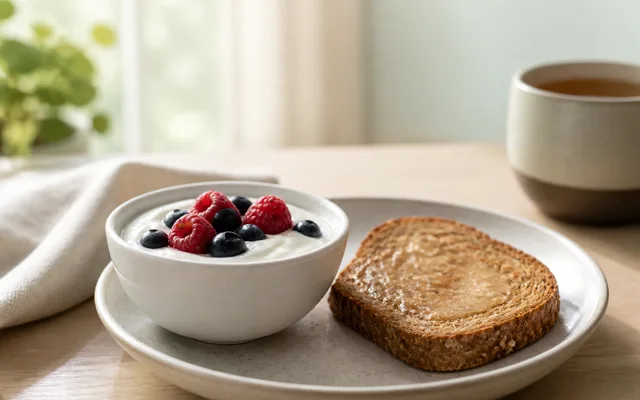
| Yogurt cup | Plain yogurt (dairy or a soy alternative; check the label) | Berries, oats stirred in | Half a cup with a few berries | Same, made the night before |
| Egg and toast | Eggs | Whole-grain toast | One egg, one slice | Hard-boiled egg made ahead, toast optional |
| Cottage cheese and fruit | Cottage cheese | Pear, apple, or berries | A few spoonfuls and a few slices | Same; nothing to prepare |
| Tofu scramble | Soft or firm tofu | Cooked or frozen vegetables, toast | Two or three spoonfuls over toast | Cubed tofu with fruit on the side |
| Warm oats with nut butter | Nut butter (also soy milk if you like) | Oats | A small bowl; stir in one spoonful | Overnight oats eaten cold |
Nuts and nut butters are high in fat, so portion size matters. 2 If a food does not sit well that morning, swap it for another from the same column rather than skipping the meal.
How do you cook eggs and keep leftovers safely?
Eggs and other raw or undercooked animal foods are on the CDC's list of riskier foods, and color and texture do not reliably show that food is done; a food thermometer does. 5 Keep raw eggs away from ready-to-eat foods, wash your hands with soap for at least 20 seconds, and refrigerate perishable food, including dairy, cut fruit, and cooked leftovers, within 2 hours. 5 That matters if you are preparing breakfasts ahead of time: a hard-boiled egg or a jar of overnight oats made the evening before should go straight into the refrigerator.
How can you add fiber without upsetting your stomach?
Add fiber gradually over a few weeks, and drink fluids with it; a sudden jump can cause gas, bloating, or diarrhea. 3 On a smaller appetite, one spoonful of oats or a few berries is a reasonable step. If you are already dealing with constipation, our article on getting fiber with a smaller appetite goes further, and the constipation article covers what to raise with your clinician.
What if nothing sounds good at breakfast?
Try one of these before deciding the morning is a loss:
- Move it later. Have the same small breakfast when your appetite arrives, instead of at a set time.
- Go cold. Cold or room-temperature food has less smell, which some people find easier. If nausea is the barrier, see nausea on a GLP-1.
- Make it a few bites. A spoonful of yogurt and a piece of fruit still counts as something.
- Prep once. Prepare two breakfasts for the week and put them in the refrigerator; a grocery list for busy weeks can help.
Skipping one breakfast is not a problem in itself. What matters is the pattern, and whether you can eat and drink enough across the day. Tell your care team if you cannot.
What should you bring to your next appointment?
| Bring | Why it helps |
|---|---|
| Three mornings of what you actually ate and drank | Shows your clinician or dietitian real intake, not a guess |
| Foods that now bother you | Helps them look for patterns |
| Any symptom that was severe or did not go away | Severe or persistent symptoms are the ones MedlinePlus says to report 1 |
| Questions about protein and fiber for you | This article gives no personal target |
For a fuller framework, start with what to eat on a GLP-1 and the seven protein meals for lunch and dinner ideas.
Common questions
Do I need a protein shake for breakfast?
Not necessarily. The ideas above use ordinary foods. Whether a supplement fills a gap in your intake is a question for your clinician or a registered dietitian.
Can these breakfasts be vegetarian or dairy-free?
Yes. Tofu, beans, nut butters, and soy products are plant protein sources. 2 Check the labels of dairy alternatives, because products differ.
References
- Semaglutide Injection — MedlinePlus, U.S. National Library of Medicine
- Protein in diet — MedlinePlus Medical Encyclopedia
- Fiber — MedlinePlus Medical Encyclopedia
- Nutritional Priorities to Support GLP-1 Therapy for Obesity — The Obesity Society
- Prevent Foodborne Illness — Centers for Disease Control and Prevention
For your information. This article provides general education and does not replace medical advice or an individual evaluation. Talk to your clinician before starting, changing, or stopping treatment. Compounded medications are not FDA-approved.